Why should you use 3D material flow simulation?
In intralogistics, good design decisions matter. A warehouse is expensive to build, expensive to change, and often expected to perform for many years. That makes the planning phase one of the most important moments in the entire project.
Most warehouse projects start with a simple question: how do we move goods in, through, and out as efficiently as possible? But very quickly, that question turns into many more. How much space do we need? How many people do we need? Which processes run in parallel? Where will bottlenecks appear? How does the operation behave on a normal day, a peak day, or a bad day?
That is exactly where 3D material flow simulation becomes valuable. A 2D floor plan can show space. A presentation can show intent. A simulation can show behavior.
Why plans alone are not enough
Warehouse layouts often look convincing on paper. You may get a polished CAD drawing, a nice animation, or even a detailed proposal with impressive numbers. And those things are useful. But they still leave an important question unanswered: what actually happens when the warehouse starts running?
Real operations are messy. Goods do not always arrive evenly. People do not always work at the same pace. A conveyor can fail. A peak day can last longer than expected. A process that looks fine in a static drawing can become a bottleneck the moment reality gets involved.
That is why simulation matters. It gives you a way to test assumptions before they become expensive mistakes.
What simulation helps you see
A good simulation does more than make things look realistic. It helps you understand how the system behaves under different conditions. For example:
-
How many orders can you really process per hour?
-
Where will queues form first?
-
What happens if one area becomes overloaded?
-
How does staffing affect throughput?
-
What happens in peak season, at night, or during downtime?
-
Does the layout still work when demand changes?
These questions are difficult to answer confidently from a static layout or a sales presentation. Simulation helps turn guesswork into something measurable.
Why operators should be involved
One of the biggest strengths of simulation is that it brings different perspectives into the same conversation. Management may focus on cost and capacity. Planners may focus on layout and investment. Operators know where the practical friction is. They know which handovers are slow, which zones are too tight, which workarounds happen every day, and which problems never show up in a clean project slide deck.
That is why the best projects are usually not built by one group alone. They are shaped by a mixed team of planners, operators, managers, and external specialists. When those perspectives come together early, the solution usually becomes more realistic, more robust, and easier to run.
What makes the difference
The real value of simulation is not just in finding problems. It is in finding them early.
A small layout change before construction can save a huge amount of money later. A process adjustment before go-live can remove a bottleneck that would otherwise live with the company for years. A different staffing model can improve peak performance without adding unnecessary complexity. Sometimes the best result is not a bigger system, but a smarter one.
That is also why simulation is useful as a neutral decision tool. It helps teams compare options in a more objective way. Instead of arguing from opinions alone, they can test scenarios, review outcomes, and choose a solution based on evidence.
Existing tools in the space
There are already several professional tools used for warehouse and material flow simulation, including AnyLogic, FlexSim, and Siemens Plant Simulation. They are powerful and widely used, especially for detailed modeling and advanced analysis.
But in practice, they often come with trade-offs: steep learning curves, long setup times, and workflows that separate modeling from the people who actually run the operation. As a result, simulation is frequently used late in the process—or by a small group of specialists—rather than as a shared decision tool.
That is the gap. The category is mature, but the process around it is not.
At RackFlow, we see an opportunity to make simulation more accessible, more iterative, and more collaborative—so it can be used earlier and more often, not just at the end.
What a better process looks like
The goal is not a perfect model. The goal is better decisions.
A stronger process looks different from the typical handoff-driven approach:
-
Teams start with realistic, operational assumptions instead of idealized inputs.
-
Warehouse operators and on-the-ground experts are involved from the beginning, not after the design is “finished.”
-
Multiple layout and flow options are explored, not just a single “best guess.”
-
Edge cases—peaks, failures, bottlenecks—are tested before anything is built.
-
Decisions are validated against how the system will actually be used, not just how it looks in a presentation.
This kind of process leads to systems that are more robust, easier to adapt, and significantly cheaper to correct before they exist physically.
Where RackFlow fits
RackFlow is designed to support exactly this way of working.
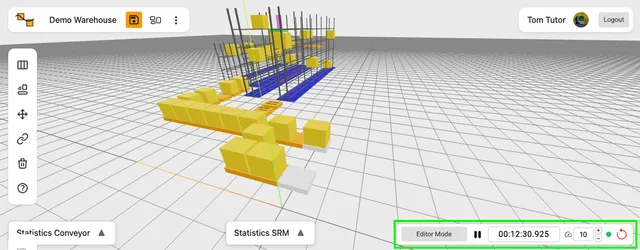
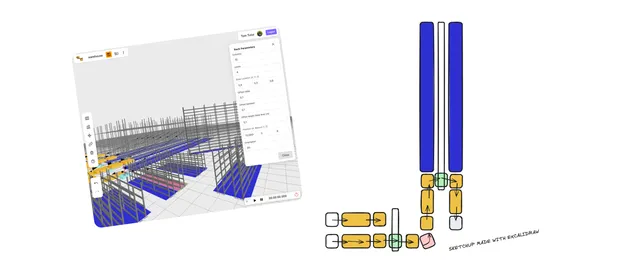
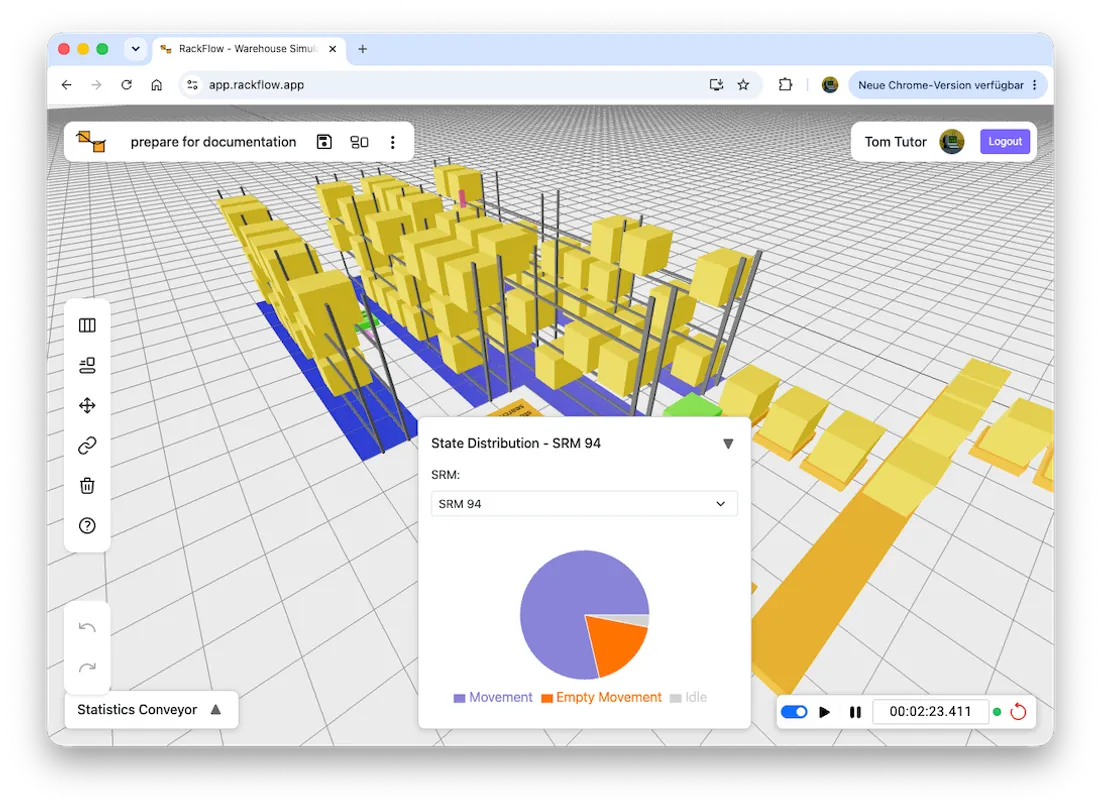
It allows teams to quickly build and compare warehouse layouts, simulate flows, and visualize behavior in 3D—so discussions can happen earlier, with more clarity and less abstraction. Instead of simulation being a final validation step, it becomes part of the ongoing conversation.
The goal is not to produce a polished model. The goal is to help teams align faster, test ideas sooner, and make better decisions together.